Desktop Pool Management
Desktop pools in xSpace tenants are managed collections of cloud desktop objects. Different types of desktop pools vary in their initial source, creation rules, and lifecycle attributes of cloud desktop objects, thus meeting the detailed requirements for daily management rules of cloud desktop resources in different scenarios.
1. Association Logic of Desktop Pools and Underlying Resources
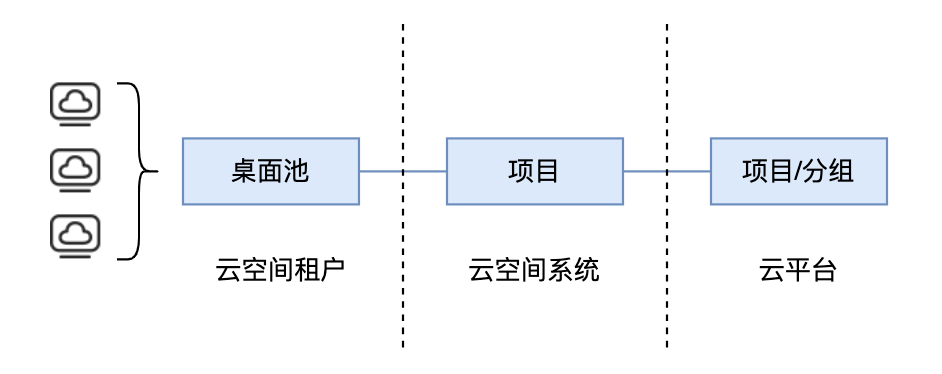
In the traditional architecture, except for hosted desktop pools, other types of desktop pools have a one-to-one correspondence with "Projects" in the system console.
1.1 Evolution of Resource Acquisition Methods
- Traditional Mode: Cloud "Project" resources usually originate from VM "Projects" or VM "Groups" pre-created in hyper-converged or cloud platforms.
- Automated Mode: On cloud platforms like OpenStack or ZStack, the system now supports automatic creation of projects and groups when creating dedicated or dynamic desktop pools, eliminating the need for administrators to manually prepare underlying resources.
2. Desktop Pool Type Description
xSpace supports the following three types of desktop pools. The definition and characteristics of each desktop pool are as follows:
2.1 Dedicated Desktop Pool
- Fixed Allocation: Desktops are statically allocated to specific users.
- Environment Persistence: The desktop operating system is not restored, retaining user habits and local configurations.
- Flexible Specifications: Desktops within the same dedicated desktop pool can have different hardware specifications and configurations.
2.2 Dynamic Desktop Pool
- On-Demand Floating: Desktops are dynamically allocated to users on demand.
- Destruction and Restoration: After a desktop is used, the system restores it by destroying and recreating it, ensuring that the next user starts with a clean environment.
- High Consistency: All desktops within the pool are uniformly created based on the associated template, ensuring a highly consistent system environment.
2.3 Hosted Desktop Pool
- Existing Resource Management: Primarily used to manage various VM instances or physical machine instances not managed via API.
- Fixed Allocation: Similar to dedicated desktop pools, resources are statically allocated to specific users.
- Environment Persistence: The system does not restore the environment; data and configurations are persistently retained.
- Management Restrictions: Due to the lack of underlying API communication, the system cannot perform desktop management operations externally (e.g., power on/off, restart). All power management operations must be completed internally within the instance or via the original management component.
O&M Tip: When choosing a desktop pool type, prioritize the user's need for data persistence. ```